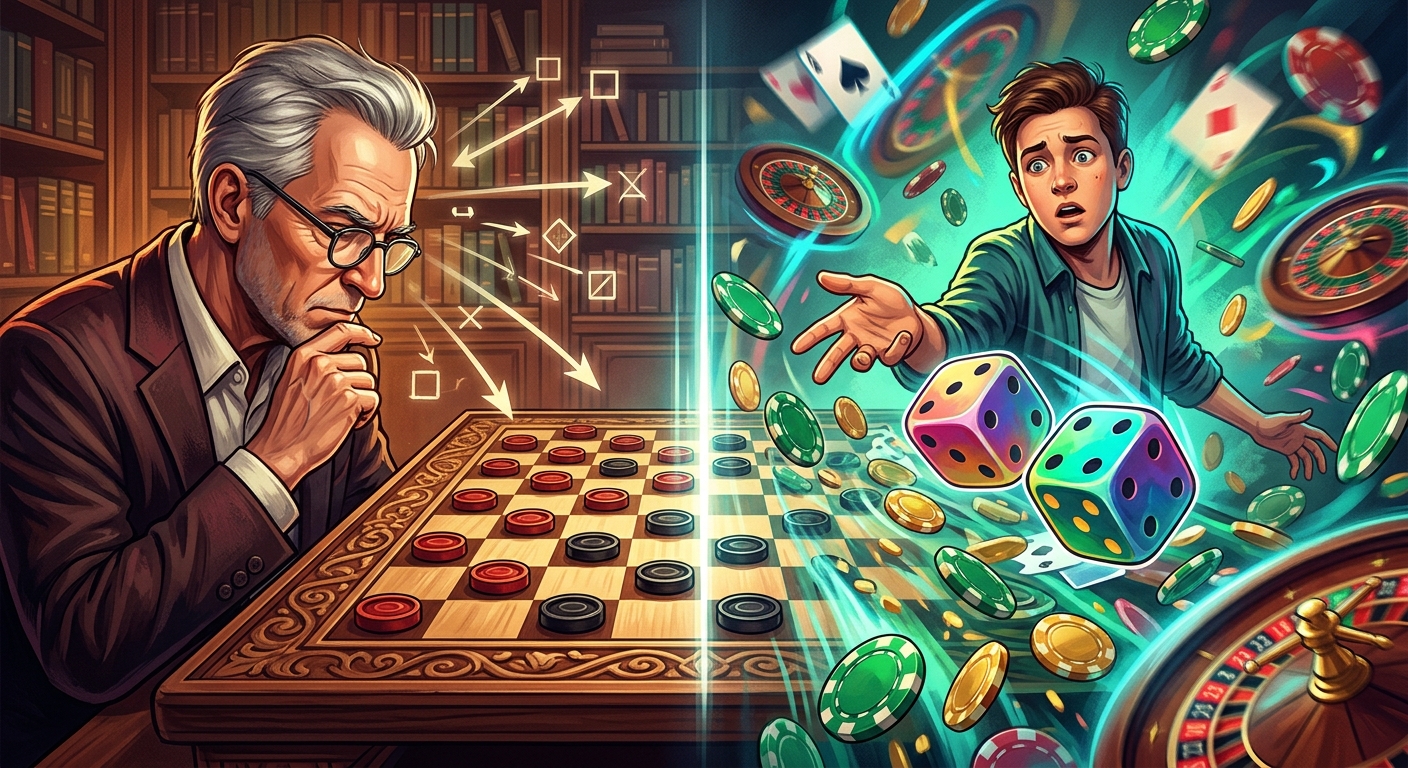
Pull up a checkerboard and you'll notice something almost immediately. There's no cup to shake. No cards to flip. No spinner to nudge you toward or away from a good outcome. Everything that happens on that board is a direct result of the choices you and your opponent make. That's not a small thing. That's the whole game.
Most people assume checkers is a beginner's game. The rules are accessible, that much is true. Sixteen pieces each. Movement in one direction to start. A board you can sketch from memory. But spend real time with it and you'll find something waiting beneath the surface. Checkers is quietly building the way you think, one move at a time.
Checkers strips luck from the equation entirely, forcing the brain to build strategic habits that chance-based games never demand.
- Positional patience trains you to hold ground and wait for the right moment rather than reacting to the first available option.
- Forced-move awareness sharpens your ability to see consequences two and three steps ahead before you commit to anything.
- Long-term sequencing teaches you to plan with the whole board in mind, not just the piece directly in front of you.
The Board Has No Dice and Why That Matters
When luck is removed from a game, something shifts in the brain. You can't deflect blame onto a bad roll. You can't credit a win to fortune. Every outcome traces back to a decision. And that accountability, even in a casual game on a Tuesday night, changes how you approach the board.
Checkers gives you a closed system. Every piece is visible from the very first move. Nothing will appear from a shuffled deck to shift the balance. The board you see at the start is the board you'll be working with until the final piece is gone. You already have everything you need. The question is only what you do with it.
This is fundamentally different from games where probability governs outcome. In those games, you manage expectations. You calculate odds. You hedge your bets and accept that some percentage of your losses were inevitable. In checkers, there is no such refuge. Every loss is a thinking error. Every win is earned, fully and traceably.
The University of Alberta's Chinook project, which computationally solved checkers after nearly two decades of work, mapped a game space containing billions of positions. That doesn't describe a simple pastime. That describes a strategic system with extraordinary depth hiding inside minimal rules.
Building Positional Patience One Move at a Time
New players want to push forward. That instinct makes sense. The goal is to reach the back row and king a piece. Forward movement feels like progress. But experienced players know that rushing without purpose creates the exact weaknesses a patient opponent will exploit several moves later.
Positional patience is the discipline of not moving just because you can. It means recognizing that a well-placed piece is worth more than a hasty exchange. It means seeing that a quiet move controlling a key square often beats a flashy capture. It means understanding that holding your structure together now can pay dividends in an endgame that hasn't arrived yet.
Checkers teaches this through failure. You advance recklessly and get punished. You trade pieces without thinking through the resulting structure and lose an endgame from a position that looked fine three turns earlier. The board doesn't explain what went wrong. It just shows you the result. You have to work backward and figure out the rest.
Over time, that process builds a habit of slowing down before acting. Of looking for what isn't obvious before reaching for what is. Players who spend serious time with checkers often notice this carry-over. They pause before decisions. They stop taking the first option that appears. The patience becomes part of how they think, not just how they play.
Forced Moves and the Art of Seeing Consequences
One of the most powerful features of checkers is also one of its most overlooked: mandatory capture. If you can jump an opponent's piece, you must. You have no choice in the matter. This single rule reshapes the game's entire tactical landscape.
Forced moves are weapons. A skilled player doesn't just see a capture. They see a sequence. They set up a position where the opponent is compelled to move into a disadvantageous square, then compelled to move again, and again, until a sequence that looked inevitable from the outside was actually scripted several turns in advance.
Learning to think in these chains is one of the highest skills the game develops. It asks you to hold multiple future board states in your mind at once. You're not calculating what happens next. You're calculating what happens after the response to what happens next. You're running a branching simulation while tracking which branches your opponent can actually enter.
The skills that develop through this kind of training are specific and genuinely transferable:
- Reading the board from your opponent's point of view, not just your own
- Identifying which of your pieces are exposed and which create active threats
- Understanding tempo, where who is forced to move can matter as much as which pieces remain on the board
- Recognizing structural patterns from past games and applying them in new positions instinctively
None of this involves guesswork. It's analysis under pressure, against someone running the same kind of simulation in reverse.
How Long-Term Sequencing Becomes Second Nature
The endgame is where everything in checkers reveals itself. Two kings against three. A piece advantage that should win but somehow doesn't. The difference between a well-played endgame and a squandered one often traces back to positioning decisions made fifteen or twenty moves earlier.
Players who haven't built long-term sequencing skills arrive at endgame positions by accident. They react move by move and hope the structure they've accumulated is good enough. Players who have built that skill arrive by design. They know which trades to accept and which to decline. They know what kind of formation gives their kings room to maneuver. They made those decisions while the board was still full of pieces.
This is genuinely hard to teach from the outside. It comes from losing games where you had a material advantage but no real plan. It comes from winning from behind because the structure you built early couldn't be dismantled. The game teaches it the only way it can: through outcomes, repeated over time, until the understanding becomes instinct rather than conscious calculation.
And once it becomes instinct, it sticks. That sense of building toward a future state, of making present decisions based on what they will leave behind, doesn't stay inside the game. It migrates.
When Strategy Meets Probability
The nature of what checkers demands becomes much clearer in contrast. Consider games that blend real skill with genuine randomness. Dice poker is a strong example. It's not pure luck. There are real decisions to make about which dice to hold, which combinations to chase, and how to read the risk of going again. Managing those decisions well is a learnable skill.
But it is a different cognitive mode entirely from pure strategy. In probability-based games, you reason in distributions. You ask what outcome is most likely, what risk is worth taking, what expected value a decision carries. Your skill lies in how accurately you assess and navigate chance.
Interestingly, checkers players who try probability-based games often notice they approach them differently. The habit of looking two moves ahead, of asking what structure a current decision will leave behind, can translate into a more deliberate style of play even when dice are involved. Strategic thinking trained on a deterministic board doesn't disappear when a random element enters the picture. It adapts.
Two Games, Two Different Demands on Your Thinking
| Aspect | Checkers | Dice Poker |
|---|---|---|
| Randomness | None | Central to every turn |
| Core skill | Positional analysis and sequencing | Probability assessment and risk management |
| Loss attribution | Always a decision error | Can be a correct decision with a bad outcome |
| Improvement path | Deeper positional understanding | Better probability calibration |
| What it builds | Strategic patience and foresight | Risk tolerance and expected-value thinking |
What Checkers Withholds on Purpose
Every feature of checkers that seems like a limitation is actually a design decision. The absence of hidden information means you can't blame your losses on not knowing what your opponent held. The absence of luck means you can't explain away a defeat with a bad run of chance. The limited piece variety means you can't rely on a powerful special unit to rescue you from a position you mishandled.
What you're left with is a game that reflects your thinking back at you, accurately and without flattery, every single time.
This is what makes checkers demanding. Other games let you play loose and still win sometimes. A fortunate card, a favorable roll, a hidden hand that happened to fit the moment. Checkers doesn't offer any of that. Imprecision compounds. A soft move early becomes a structural weakness mid-game. That weakness becomes a lost piece. That lost piece becomes a loss. The chain is traceable, always, from start to finish.
But that same honesty is what makes the game worth studying seriously. Every session is feedback. Every loss tells you something specific, if you're willing to trace it back to where the trouble started. There's no lucky opponent to blame. There's no bad draw to regret. Just two people thinking, and one of them thought a little more clearly that day.
What Remains When Luck Leaves the Room
Strip a game down to its essentials, remove every element of chance, and you get something close to an X-ray of the mind at work. Checkers is that X-ray. It shows you exactly how you plan, how patiently you wait, how well you see consequences, how clearly you reason when there's nothing to hide behind.
That's why checkers players tend to talk about the game differently from players of chance-based games. They don't talk about runs of luck or bad beats. They talk about positions. A move they missed. A trade they made too soon. A sequencing error three turns back that only became visible five turns later. The vocabulary changes because the game changes what you pay attention to.
This is the real gift checkers gives you. Not just better play on the board, but a sharper set of cognitive habits that carry into decisions well beyond it. The discipline of not acting on the first thing you see. The patience to build toward a future position rather than react to the current one. The honesty to look at a bad result and ask where your thinking went wrong, rather than blaming the cards.
If you want to improve at checkers, you have to improve at thinking. There's no shortcut through probability. There's no deck to hope for. The board in front of you is the whole story. And every move is entirely yours to make.
That's not a limitation. That's the point.